 |
| |
 
 
|
Fly:
Hans van Klinken, Photographs above: Hans Weilenmann
|
| Hook: |
Partridge GRS12ST
or GRS15ST size 12 |
| Thread: |
Uni thread 8/0 Black |
| Underbody: |
Leadwire (shank one layer,
thorax double) |
| Rib: |
Monofilament 0,20mm at least 12
windings |
| Wing: |
Furry foam or dubbing |
| Shellback: |
Flexibody |
| Thorax: |
Fitch or mink (dark brown)
dubbing well picked out |
| Head: |
Black |
THE CASELESS CADDIS LARVA
Examine the gullet of just about any trout caught at just about
any time of day, and just about any time of year, in just about
any water, and the changes are you will find at least one caddis
larva. Examine just about any submerged rock of stick, or
disturb the bottom sediment on just about any piece of fresh
water, and the changes are you will find caddis larva. A large
number of them are those omnipresent little buggers that make
those cases out of spruce needles, or tiny sticks or even fine
gravel or weeds. On the other side you have a large group of
caseless ones. For trout it doesn't matter if they are cased or
not. Trout really love them. On a season-long base, caddis
larva's are arguably the most prolific trout food and we are
crazy not to use them. A caddis larva imitation should be in our
fly boxes at all times. IMITATIONS
In 1986 I started to collect caseless caddis species from
several rivers, which I tried to imitate as close as possible
during the winter months. The first patterns I tied were not
pretty looking creatures, but rougher bottom bouncers. They were
a little too heavy and too bulky and did not look like the real
insect I was trying to copy. However, the flies worked
reasonably well. Despite this, I discovered that it was not easy
to tie realistic nymphs! Improvements were made several times
but still I was not satisfied. My large Scandinavia nymph was
even better and I had more confidence in them because he had
proved to be very effective all over Europe. It is no secret
that the caseless caddis imitations, which I use today where,
developed after some long discussions with England's Oliver
Edwards, accepted as one of the finest fly tiers in Europe. I
told him a lot about my large Scandinavian patterns, fishing
techniques and thoughts. We are good friends and share each
other secrets and techniques without hesitation. Oliver taught
me not only how to study the anatomy of an insect, but he also
showed me how to combine and handle natural and synthetics in a
more effective way. He also convinced me that heavily leaded
patterns are not always better catchers then sparsely weighted
nymphs. Nowadays I even believe that under some circumstances
unweighted patterns can be more effective then weighted ones.
The first prototypes of the Caseless Caddis in my series were
developed in the winter of 1987. At that time I still tied my
patterns in probably 15 different colours. The first successful
attempts to use the caseless caddis occurred in a Germany river
where my friend Jack and I caught plenty of fish with this very
effective nymph pattern. Now I use mainly yellowish and greenish
variations. Therefore I have large quantity and sizes of those
colours in my fly-box today. IMPROVEMENTS
After my conversations with Oliver, it was time to experiment. I
improved several of my patterns in the first months of 1988 and
tried to give them a more realistic and better-looking
appearance. One of them was my imitation of the caseless caddis
nymph. I think I had learned a lot from Oliver vision about
realistic nymph patterns very much. About the same time Gertjan
Doedens, another Dutchmen designed a similar caddis larva. His
idea of using flexibody as back material finally led me to this
excellent caddis larva imitation. The reason that I used a
curved hook to present my caddis is because I find out that
disorientated larva often will drift in this way. This is why I
mainly fish the pattern in a dead drift. FISHING, RESULTS AND TECHNIQUES
The caseless caddis proved also to be an excellent pattern for
beginners. It is easy to tie and extremely easy to fish with. I
fish the Caseless Caddis mostly in dead drift and therefore
blind, but when the conditions are right I love it to fish this
pattern by sight in clear water. In deeper or more coloured
water where I can not see any fish I always use a fine
bite-indicator which I put directly on the connection loop where
tippet and braided leader are knotted together. I fish it in an
upstream dead drift, watch the bite-indicator and set the hook
at any movement, no matter how small and trivial it sometimes
might be. With this fishing technique even brooks or small
streams with a lot of weed are much easier to handle. The second
reason for using a bite-indicator is to present the nymph on the
right depth. TYING TECHNIQUES
STEP by step
photographs: Leon Links
- Put fine lead wire on the
hook shank (two layers around the thorax). Optionally coat
with varnish.

- Tie in 0.20mm/0.08"
diameter clear monofilament for use as rib and to create the
body segmentation.
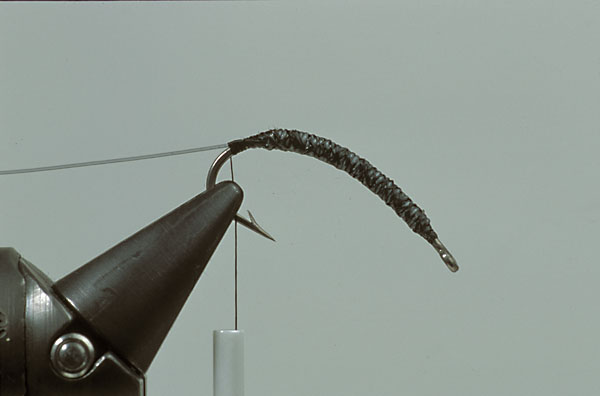
- Secure the underbody well
with thread and lacquer to be sure the materials will be not
twist around the hook shank when the fly is finished.
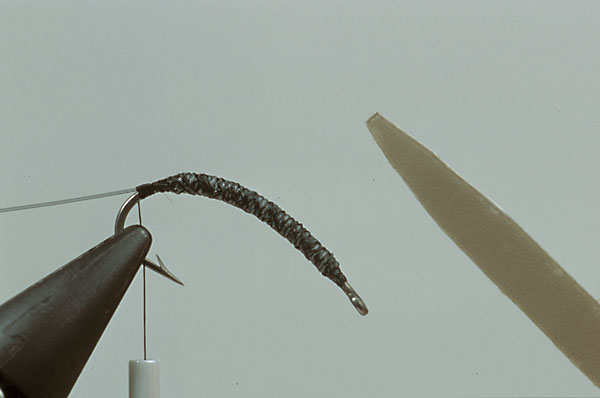
- Cut out a small piece of
transparent flexibody in the shape as shown in the
photograph.
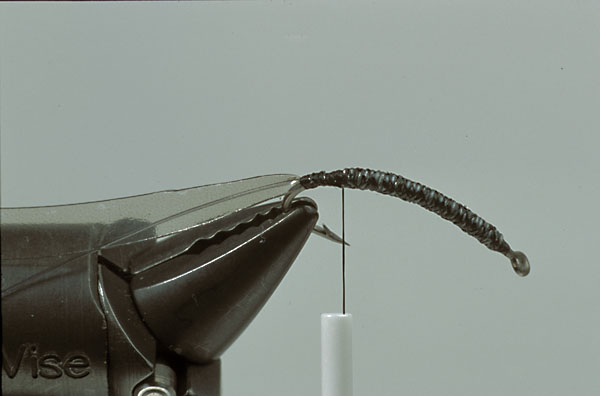
- Tie in the strip of
flexibody.

- Tie in a narrow strip of
Furry foam. If furry foam is not available use hare-tron or
fine dubbing material.
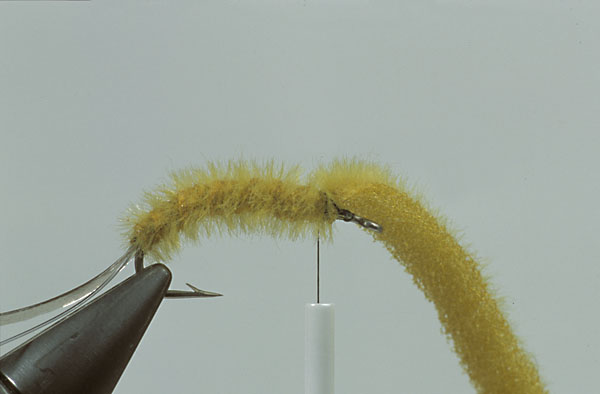
- Wrap the furryfoam around
the shank to form the abdomen.

- Use some dark mink or fitch
guardhairs/underfur spun in a dubbing loop for the thorax.
Make a well defined thorax.

- Pull over the flexibody.
Secure it with your tying thread.
- Wind the monofilament in at
least 12 turns to the eye of the hook and tie off. You have
now a good and effective segmentation, which is of vital
important for this pattern.

- Pick out the mink hairs to
define the legs, and the Caseless Caddis is complet
|
Foto's tying
steps Lèon
Links
|
|
|

|