spacer Fly fishing in the Yukon by Hans van Klinken
spacer

With a rather good knowledge about the fly fishing possibilities in the Yukon and North-east British Columbia it’s nice to share your experience with others. I am not an expert but just a passionate fly fisherman. Pacific salmon runs attract people, a lot of people, but there are not so many pacific salmon and steelhead in this part of North America and maybe that’s one of the reasons why I love the fly-fishing in the Yukon so much. There is hardly any fishing pressure and the fly-fishing is relatively new as well. Most fly fishermen that have fished the Yukon over the years came from abroad anyway. For local people, lake fishing is the most popular way to catch their fish and that’s probably why it is so well reviewed in fishing guides and reports. There isn’t much information about river fishing available and there is a lot to explore and discover. The opportunity of fishing unknown waters is what I like very much and The Yukon offers the fishermen hundreds of wonderful streams, brooks, and rivers that are still peaceful and unspoiled.

Lake Whitefish

At first there is a real big challenge to fish for six species of whitefish. There is not much information about whitefish in Europe available and in the early eighties I believed there were only three species. Today I know there more then 30 different species all over the world and several of them living in saltwater only. When I talk about a real challenge I mean that fishing for whitefish by fly is not easy and maybe that’s why such a few people are fishing for them. Many people still believe that whitefish only exist in lakes but this is not true. It depends on the species. There are some species that stay in the lakes during the wintertime but as soon as the rivers start to flow again they move up or even downstream. Whitefish all over the world are an important species in the food chain. In the Yukon they are food for lake trout, pike and even big whitefish. If you find a place with a lot of whitefish you can be sure there is an excellent fishing for other species as well. Because the whitefish feed most of the time in the shallows of the lakes during summertime you can select one fish and try to catch it on sight, which surely is one of the most beautiful ways of fly-fishing. I have caught many fish on sight and it always makes my day. If you finally hook one you will quickly discover that they fight much stronger than grayling but the risk of loosing them during your play is pretty high. Depending on the species the landing chances easily can be 40% only! This of course is because of their small and very soft mouth. You will need some nice tricky flies to prevent slipping of the hook too easily. With curved hooks I finally increased the landing percentage up to 90%, which is an old trick from my Scandinavian experiences.

The most spectacular catch by far was the catch of our first inconnu. This species is the biggest of all whitefish and is better known as the tarpon of the north. They easily can reach sizes more than one meter. Why the inconnu grow so big in the Yukon is still unknown. There is still a lot to learn about this wonderful and rare whitefish and people have discovered them at more and more locations over the last 10 years. The inconnu seems to like big muddy and silt filled rivers and associated lakes and the Yukon has plenty of them. Some people told me they live in the big lakes and spawn in the rivers that feed the lakes. Other stories say that they come from the Arctic Ocean and followed the drainages to the south. However, one thing is striking: The fight of the inconnu is the most amazing I ever seen and because we using light tackle and flies the fish can be played more freely than when hooked with a big heavy spoon on a stiff powerful rod.

Grayling
Arctic Grayling

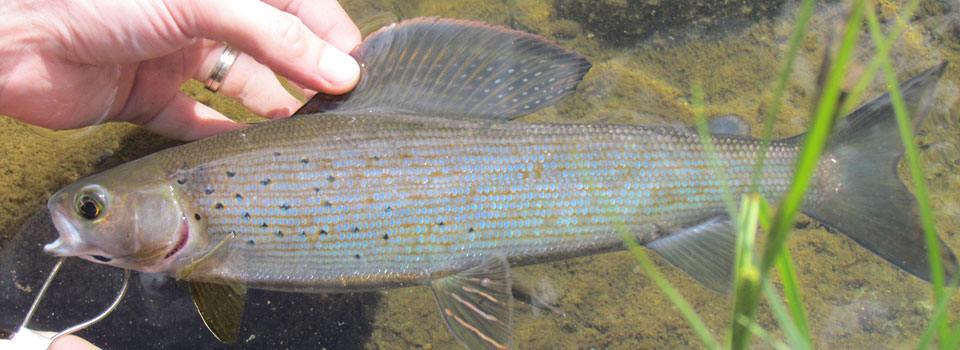
Another of The Yukon’s favourites is the arctic grayling. Grayling fishing in North America is completely different from what we know in Europe. I have had dozens of discussions about all of the special flies I use for grayling fishing and there are still many people that don’t believe that big flies for grayling work well. I proved them wrong many times but unfortunately the old rule that you should use only small flies for catching grayling is still very much in use. People who still believe in this rule shouldn’t go to the Yukon, BC, NWT, Scandinavia or Alaska. In my personal opinion there are two groups of Arctic grayling in the Yukon. Of course there is only one species but it feels so nice to split them apart. The first group can be considered as the insect feeders. I also see them as the un-exhausted leapers and we mainly caught them in the Yukon Rivers or feeders and outlets from the lakes. You fish for them by light tackle and large dry flies or you use some nice realistic nymph imitations. During their play they jump fanatically and sometimes very often too. Because most local people fish for them by spoons and little spinners they will miss the magnificent and acrobatic leaping qualities of the Arctic grayling. A spoon simply will prevent them to show this wonderful spectacle. At several rivers we recorded fish that jumped 15 times like a real salmon in just one simple fight. Some could leap for almost a meter straight in the air and we were very fortune to shoot this on camera! The second group of grayling I can describe the best as the aggressors. These fish take everything and we caught many of them while we fished with big nymphs or streamers for lake trout. To be honest I don’t like this latter group very much especially not when I hook them on heavy equipment. They are much too different from the lady of the stream that we know so well in Europe. Their aggression is far away from any ladies behaviour. The strong fight the grayling gives you is very striking and in my opinion their play is much more powerful then we are used in Northern Europe. The reason for this must be because they have more volume and aren’t as slim as the fish we used to catch in Norway, Sweden and Finland. Not all rivers in the Yukon have grayling or have grayling all year round and it surely has to do with the strong and long wintertime and depth of the river. Some rivers only hold grayling during summer and this surely are fish that stayed behind after spawning. Most grayling will be found in the Yukon lakes and the rivers that connect lakes.

Lake Trout

The species what surely makes the Yukon so interesting for fly fishermen is the lake trout (savelinus namaycush). It’s a member of the char family but not many people like it when you call them char. They are big (up to 40-50 pounds) and they surely are the most powerful fish in the Yukon. I am convinced there are more then one species in the Yukon but I am not a scientist, I only do observations and there are so many differences between the lakers that I’ve caught that I am certain some of them have to be another species or at least a hybrid. I’ve even heard of a lake that has lake trout which has a completely purple mouth inside. Maybe that’s another species too. The biggest fish usually take the biggest flies but I’ve often caught fish around 4-6kg on nymphs and dry flies when I am using light tackle while fishing for grayling. This is a very risky action that requires a soft rod to prevent leader snapping. Although lake trout are known as excellent day feeders, I’ve caught my biggest fish during night fishing or while fly-fishing during dull and dark days. For me this is the prime time for catching the biggest specimens. The most exclusive lake trout fishing I did at times when the lakers are feeding at the surface on sedges and beetles in the shallows. This is the best time for dry fly fishing. Those fish are usually between 2 and 4kg and give and excellent fight on very light dry fly equipment. If you want to go after those real big monsters you will need at least a stiff #8 rod and long heavy sink tip lines. With a soft rod it will take ages to land the fish and they could be damage by too intensive playing. Amazing is the fall time (September) when the lake trout shoal up and prepare themselves for spawning at gravel beaches around little islands and feeders. Lake trout also is present in most watercourses.  

Dollies and other species

Dolly Varden

Dolly Varden can also be found in the Yukon and they can reach sizes of up to 18 pounds. To fish for them you will need some good local information because you only will find them in certain watercourses. It’s the same with Arctic char and wild rainbows. Both species are stocked at several places but also can be found in the wild. The Peel River and North Slope drainage have a good population of arctic char. The Kathleen River is probably the most famous place to fish for wild rainbows. The Liard drainage is the only system that holds some bull trout. Pacific salmon and steelhead are most abundant in the Alsek and Yukon River drainage. 

Maria or Burbot
For fly fishermen this fish is better known as the Burbot. It is extremely hard to catch. So far I only know of a few catches by fly.

Northern Pike

Finally there is the great Northern pike. The pike fishing in the Yukon has increased enormously during the last few years. I have met several people who only come to the Yukon to fish for pike and I can understand that very well. The reason is quite simple. The Yukon and NWT offers the fly fisherman some of the most spectacular pike fishing you will ever experience. When you hit the right conditions it is no problem to catch several fish over a meter in one single day. A bit of stormy and cloudy weather with very bright sunshine in between seems to be a good day to go after them but personally I prefer to catch them at dull and dark windy days. I only fish for pike one or two days each trip because the catches can be so plentiful sometimes that the challenge easily can fade away! Amazing for European standards is the spawning behaviour of the northern pike. They dig big holes while spawning and that is something I never have seen before because most of our pike spawn in the weeds and grass when rivers are flooded.

Other species that you can find in the Yukon are the kokanee salmon, burbot, long nose sucker, white sucker and sculpin.  

Feeding and fighting behavior of the lake trout

The average sized trout feeds heavily on snails, nymphs, shrimp (scuds), and smaller fish. Since they have only about 3_ months to eat and store necessary fat for the coming 8_ months of lean winter, they eat prolifically, utilizing any available protein. They are even willing to scavenge. Flies can catch enormous lakers indeed but you will need to go out when the weather conditions aren’t very nice in a boat that’s not very pleasant and you have to be careful too because mountain winds can be unpredictable. Fortunately everything has a good side too. When a lake in the Yukon quickly gets stormy, you just go on shore while the storm blows over and disappears as quickly as it surprised you. I have never had to wait longer than an hour so far but of course this is not guaranteed. Let’s get back to the big monster fish. They usual stay deep and feed at the bottom. The best way to catch a big laker by fly is at night when they come up from the deeps and feed on the steep drop offs or even hunt after whitefish and grayling on the shallows. They can handle enormous flies and I caught several by accident while fishing for pike with our famous Dutch Pike streamers better known as half chickens!

Lake trout have a unique way of fighting. Frequently, when initially hooked, they provide only token resistance until they see you or the boat or belly boat. Then all politeness disappears quickly and a real strong fight begins. Although they rarely become airborne, lake trout do make very strong runs and demonstrate commendable strength. Even the smaller ones really don’t jump but when they run you will notice that clearly. A good and long backing will be indispensable. People who don’t fish often will smash a brand new 5 lbs tippet in seconds easily when the laker start its run. Once they are brought closer to the boat or float tube, lakers change tactics. Frequently they begin indescribable gyrations around a fixed point somewhere within their heads. As a result they either wind themselves up completely with coils from the leader, or they pull the fly out of their mouth and get away. I have seen lakers pulling doubles or treble hooks out of their mouths using this method. I fish single hook and barb less very fanatically and I’ve never had any clear proof that a double or treble hook will land more fish. Because of this powerful fighting method I highly recommending people NOT to use big barbed hooks or doubles and trebles because damage is enormous when fish escape during a fight. Another method, implemented by the trout when brought toward shore, is to dive nose first into weeds or sand and thus rub the fly out of their mouth. They succeed well with this trick.


Web Design by
Meadia Solutions - YukonWeb Design